 Live webinar


Private Equity vs Venture Capital: How Their Data, AI and Technology Strategies Differ

- 6 min read
- October 26, 2026
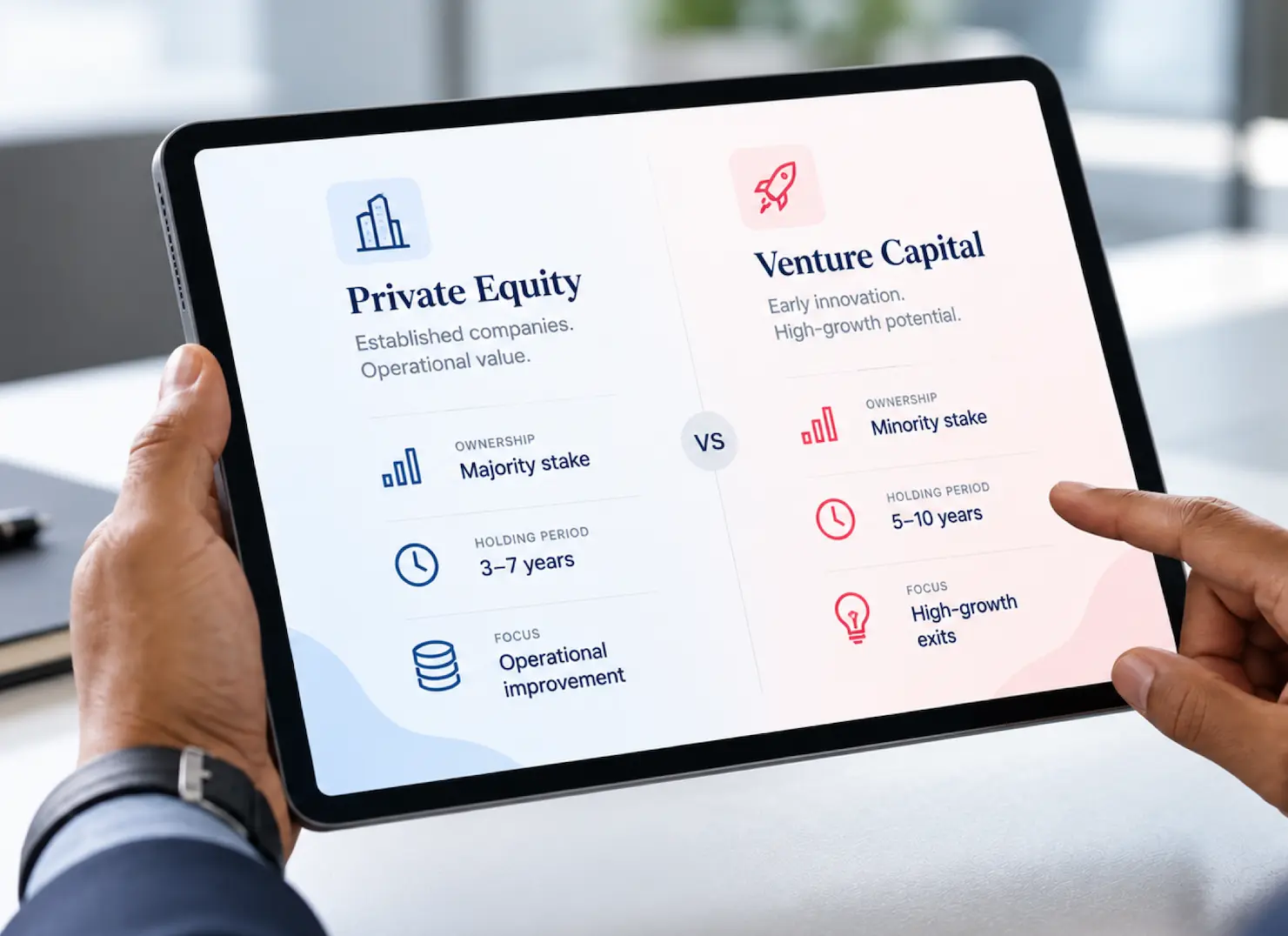
Private equity vs venture capital differs in ownership, investment strategy, and technology requirements. Private equity typically acquires controlling stakes in established, cash-generating companies, often using debt, while venture capital takes minority stakes in early-stage, high-growth startups. Consequently, PE uses data and AI to improve operational performance across controlled businesses, while VC prioritizes identifying promising startups at scale. For PE firms, this distinction makes connected data, institutional memory, and AI governance essential.
4 min read
- October 26, 2026
Private equity vs venture capital differs in ownership, investment strategy, and technology requirements. Private equity typically acquires controlling stakes in established, cash-generating companies, often using debt, while venture capital takes minority stakes in early-stage, high-growth startups. Consequently, PE uses data and AI to improve operational performance across controlled businesses, while VC prioritizes identifying promising startups at scale. For PE firms, this distinction makes connected data, institutional memory, and AI governance essential.
- Private Equity vs Venture Capital: The Key Differences at a Glance
- How PE and VC Firms Use Data Differently
- How AI Is Used Across the Deal Cycle: PE vs VC
- Technology Stack and Team Set-Up: Where PE and VC Differ
- What This Means for Private Equity Firms Building an AI Strategy
- Frequently Asked Questions
Private Equity vs Venture Capital: The Key Differences at a Glance
Venture capital is technically a subset of private equity. However, private equity vs venture capital typically refers to buyout investments versus startup funding. PE emphasizes operational improvements, cash flows, and debt repayment. VC seeks substantial returns through rapid growth and successful exits.
| Feature | Private Equity | Venture Capital |
|---|---|---|
| Company Stage | Mature, established businesses | Startups and scaleups |
| Ownership Stake | Typically majority (51–100%) | Typically minority (10–30%) |
| Funding Structure | Equity and acquisition debt | Primarily equity |
| Companies per Fund | Often 10–15 | Often 30–100+ |
| Holding Period | Typically 3–7 years | Typically 5–10 years |
| Source of Returns | EBITDA growth, operational improvements, debt paydown | High-growth exits |
| Main Data Need | Historical financials, EBITDA, LBO models | Market signals, founder profiles, traction |
Figures are illustrative ranges, not universal fund benchmarks.
Your PE firm deserves intelligence built around its investment lifecycle. Discover how Kairos connects data, decisions, and workflows.
How PE and VC Firms Use Data Differently
The central data distinction in private equity vs venture capital is depth versus breadth.
PE: Analyzes historical EBITDA, enterprise resource planning (ERP) data, cash flows, and operational KPIs across multi-year holding periods.
VC: Evaluates founder backgrounds, market trends, web traffic, product adoption, and early growth indicators across extensive startup pipelines.
PE therefore needs governed ingestion pipelines and connected financial records. VC prioritizes broad market intelligence and rapid screening.
Explore tracking portfolio data to understand PE reporting requirements.
How AI Is Used Across the Deal Cycle: PE vs VC
AI priorities differ across three investment stages:
PE identifies acquisition targets and strategic add-ons. VC screens startup pipelines and pitch decks.
PE analyzes confidential information memoranda (CIMs), quality of earnings, data-room risks, and investment committee (IC) memos. VC validates market size, founder capabilities, and early traction.
PE monitors operating KPIs, spending, board reports, and value-creation initiatives. VC tracks growth, capitalization tables, and follow-on funding opportunities.
Explore how private equity teams use AI across investment workflows.
Technology Stack and Team Set-Up: Where PE and VC Differ
Requires governed platforms connecting DealCloud, Snowflake, portfolio systems, and fund administration. Operating partners, finance teams, and technology leaders oversee data quality, permissions, and AI workflows.
Often favors lightweight CRM tools, sourcing engines, cap table platforms, and lean technology teams.
PE also needs institutional memory and auditable reporting across the private equity fund life cycle. Both face regulatory obligations, although SEC registration requirements differ by adviser status.
What This Means for Private Equity Firms Building an AI Strategy
The private equity vs. venture capital comparison highlights why PE needs more than standalone AI applications.
- Unified Data: Connect deal, portfolio, fund, and investor information.
- Institutional Memory: Preserve investment theses, historical IC decisions, and LP obligations through a compound knowledge graph.
- Governance: Apply role-based access, audit trails, human validation, and data lineage.
- Operational Intelligence: Support portfolio monitoring, waterfall calculations, and LP reporting.
Kairos by Brownloop provides an intelligence operating layer designed to connect institutional knowledge, govern AI workflows, and support firm-specific decision-making.
Frequently Asked Questions
 Is venture capital a type of private equity?
 Yes. Venture capital is a specialized branch of private equity focused on startups, while the term private equity commonly describes controlling investments in established businesses.
Which is better for startups: private equity or venture capital?
Which is better for startups: private equity or venture capital? Venture capital generally suits startups seeking growth funding. Private equity typically serves established businesses. The right choice depends on business maturity, capital requirements, and desired ownership control.
How do venture capitalists decide which startups to invest in?
How do venture capitalists decide which startups to invest in? Venture capitalists assess founding teams, market potential, product traction, and growth prospects. Data analytics and AI increasingly help screen opportunities before deeper partner-level investment evaluation.
Your PE firm deserves intelligence built around its investment lifecycle. Discover how Kairos connects data, decisions, and workflows.


