 Live webinar

Modernizing Private Equity Due Diligence with Kairos Deal 360

- 5 min read
- November 23, 2026
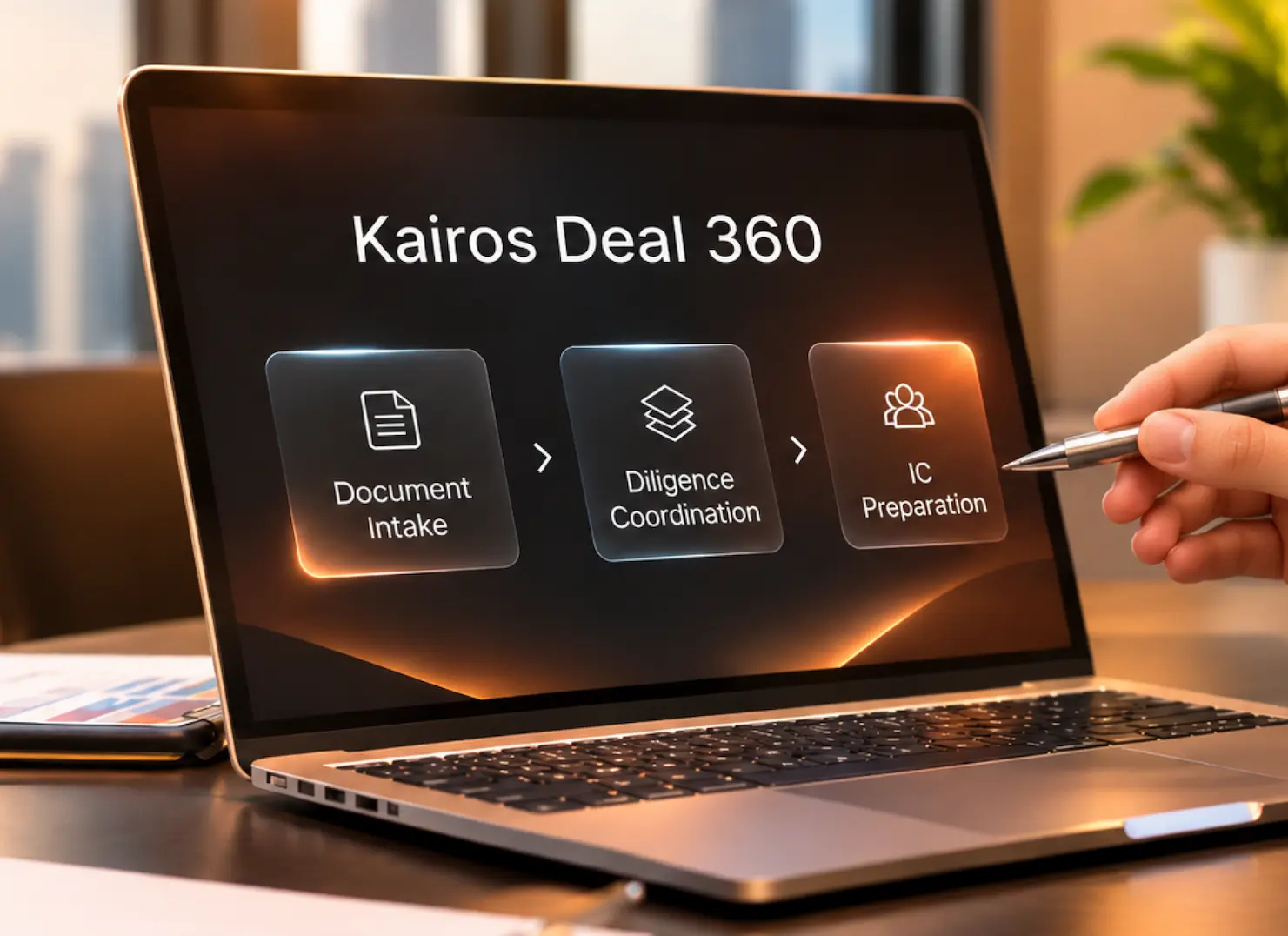
Modernizing private equity due diligence means connecting documents, deal data, and historical investment knowledge. From exploratory diligence through confirmatory diligence and investment committee review, this reduces repetitive information gathering and gives deal teams more time for judgment.
General
Portfolio Management
5 min read
- November 23, 2026
Why Private Equity Due Diligence Takes So Long
Private equity due diligence takes time because information sits across virtual data rooms, spreadsheets, and email conversations. Each new transaction often requires teams to repeat analysis instead of building on previous investment experience.
Four recurring bottlenecks create delays:
Analysts extract financial metrics and contract terms separately for every transaction.
Teams revisit similar commercial, financial, and operational questions without standardized reference material.
Risks and observations remain in separate files, forcing analysts to reconstruct the investment committee (IC) memo.
Previous deal assessments and investment decisions often remain with individual professionals.
These gaps become more visible when multiple advisers and workstreams must contribute to the same investment decision.
Connect deal documents, streamline diligence workflows, and turn institutional knowledge into actionable intelligence. Discover how Kairos helps investment teams move from manual analysis to more informed decisions.
What Modernizing Due Diligence Actually Changes
Modern diligence replaces disconnected document reviews with connected deal information and reusable investment knowledge. Instead of rebuilding analysis for every transaction, teams can compare new evidence with historical decisions and established investment criteria.
| Diligence task | Traditional approach | Modernized approach |
|---|---|---|
| Document and CIM review | Analysts manually extract information from individual files. | Automated extraction organizes key information for review. |
| Risk flagging | Red flags emerge through separate reviews. | Connected analysis highlights discrepancies across documents. |
| IC memo preparation | Teams assemble findings from spreadsheets and emails. | Structured findings feed a consistent memo draft. |
| Retaining deal knowledge | Insights remain in archived files. | Decisions and supporting evidence remain accessible. |
This approach supports consistent evaluation without removing responsibility from investment professionals.
How Kairos Deal 360 Supports the Diligence Workflow
Kairos Deal 360 connects sourcing, diligence, investment committee preparation, and deal closing within a governed workspace.
Its workflow supports three important stages:
Analyze confidential information memorandums (CIMs), extract financial metrics, and compare opportunities against previous deals.
Track workstream ownership, review progress, and flag inconsistencies between financial statements and deal documents.
Generate draft investment memos, capture committee feedback, and track approval decisions.
Its institutional memory layer preserves investment reasoning and findings for future transactions.
Brownloop’s CIM automation case study documents an implementation, while its guide to AI in due diligence explores the broader technology approach.
Operational Due Diligence: Where Automation Helps Most
Operational due diligence examines how a target company operates, including its systems, controls, people, and reporting processes. Fragmented evidence makes it difficult to assess operational risks and estimate post-acquisition integration requirements.
Automation can support five activities:
Document technology dependencies, integrations, and data flows.
Organize evidence of governance, approvals, and internal control weaknesses.
Identify key-person dependencies and gaps in operational responsibilities.
Compare management information with underlying financial and operating records.
Convert identified risks into priorities for the first 100-day plan.
For deeper document review, deal book analysis provides additional context. The broader diligence disciplines are covered in Brownloop’s private equity diligence guide.
Bringing Modern Tooling Into an Existing Diligence Process
Modernizing an established diligence process does not require replacing every system. A general partner (GP) can begin with one measurable workflow, test it against existing practices, and expand based on demonstrated results.
- Select one workstream: Prioritize repetitive tasks such as document analysis or risk tracking.
- Connect information: Bring relevant documents, financial data, and prior findings into an accessible workspace.
- Define completion: Specify the evidence, ownership, and approval requirements for each finding.
- Test on a live deal: Compare automated outputs with the existing review process.
- Retain knowledge: Store verified findings and decisions for future transactions.
Brownloop’s case study on faster DDQ responses illustrates workflow standardization in investor due diligence. Human reviewers must validate AI-assisted findings before IC submission.
Frequently Asked Questions
 How does operational due diligence differ between private equity and hedge funds?
 Private equity operational due diligence examines a target company’s systems, processes, and management capabilities. Hedge fund operational due diligence typically evaluates the investment manager’s internal controls, trading infrastructure, custody arrangements, and operational risks.
What should investors look for during operational due diligence?
What should investors look for during operational due diligence? Investors should assess whether reported performance aligns with underlying operational evidence. Important warning signs include inconsistent financial reporting, weak internal controls, dependence on key employees, outdated systems, and potentially expensive integration requirements.
Who provides private equity due diligence services?
Who provides private equity due diligence services? Accounting firms conduct financial reviews, strategy consultancies assess commercial risks, and specialist advisers examine legal or technical issues. Technology partners such as Brownloop support the underlying data integration, analysis, and workflow infrastructure.
Connect deal documents, streamline diligence workflows, and turn institutional knowledge into actionable intelligence. Discover how Kairos helps investment teams move from manual analysis to more informed decisions.


