 Live webinar


Private Equity vs Hedge Funds: How Data and Technology Shape Investment Decision-Making

- 5 min read
- November 06, 2026
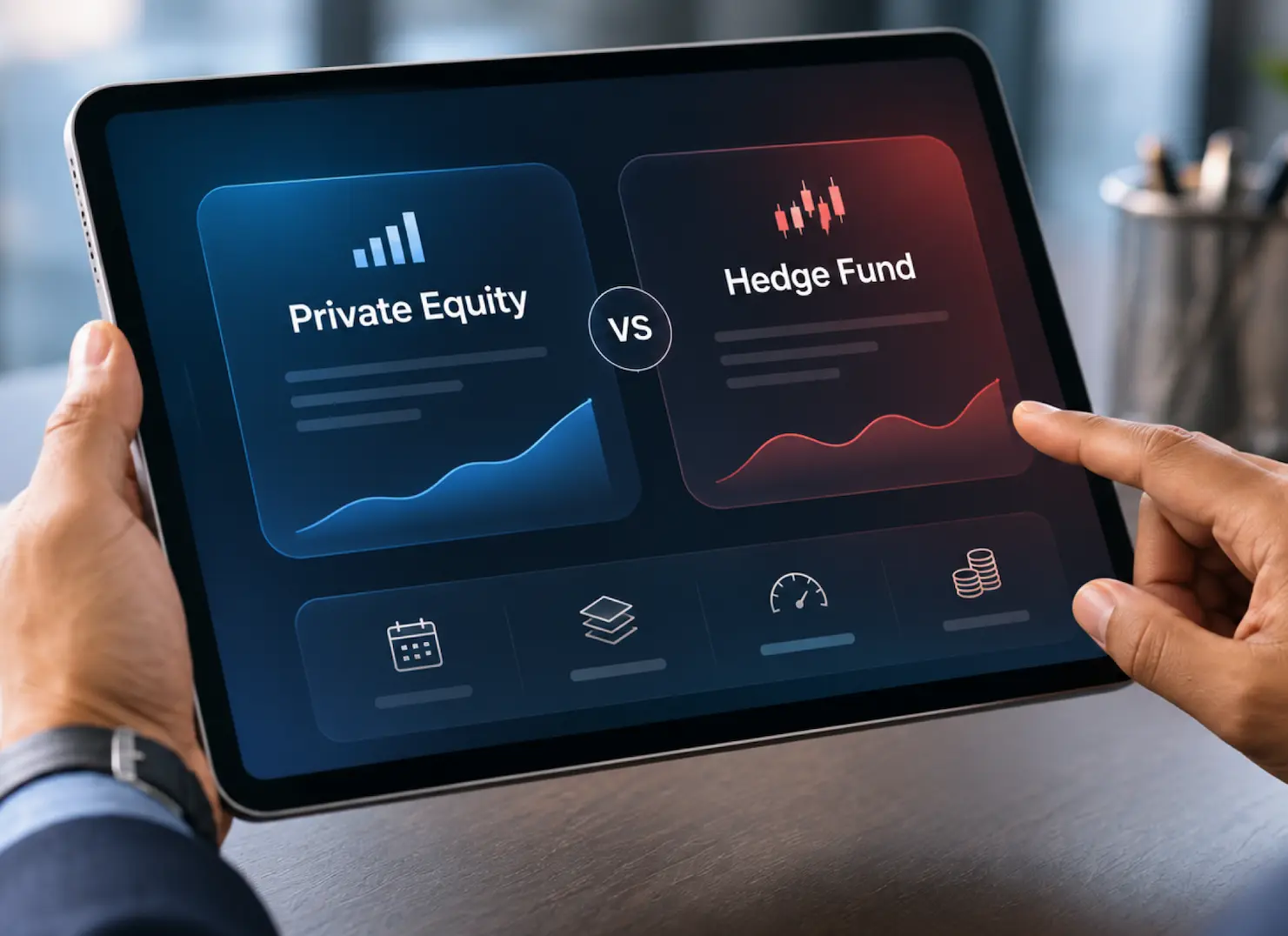
The distinction between private equity and hedge funds extends beyond investment strategy to how each processes information, evaluates risk and allocates capital. Hedge funds trade liquid, predominantly public assets to pursue shorter-term opportunities, while private equity firms acquire and develop businesses over several years.
General
Data Analytics
5 min read
- November 06, 2026
The distinction between private equity and hedge funds extends beyond investment strategy to how each processes information, evaluates risk and allocates capital. Hedge funds trade liquid, predominantly public assets to pursue shorter-term opportunities, while private equity firms acquire and develop businesses over several years.
Private Equity vs Hedge Fund: What Is the Difference?
Both are pooled alternative investments serving institutional investors and eligible high-net-worth individuals. However, their investment horizons, ownership structures, liquidity provisions, and decision-making models differ significantly.
| Area | Private Equity | Hedge Fund |
|---|---|---|
| Investments | Primarily private companies | Primarily public securities |
| Holding period | Typically several years | Seconds to years |
| Control | Often significant ownership and operational influence | Usually limited operational control |
| Liquidity | Capital committed for extended periods | Strategy-dependent lock-ups and redemptions |
| Fees | Management fee and carried interest | Management and performance fees |
| Investors | Institutional LPs and qualified investors | Institutional and eligible accredited investors |
| Data sources | CIMs, financials, diligence reports | Market feeds, alternative data, quant models |
The life cycle of a PE fund makes long-term information continuity particularly important.
Private equity does not need faster trading. It needs accessible, governed investment intelligence. Brownloop’s Kairos helps firms preserve institutional knowledge and connect decisions across the investment lifecycle.
How Hedge Funds Use Data and Technology
Hedge funds prioritize speed, signal detection, and continuous portfolio recalibration. Their investment decisions often rely on:
Live prices, liquidity, volatility, and trading volumes.
Consumer spending, satellite imagery, and web traffic.
Statistical signals, backtesting, and algorithmic execution.
Earnings releases, filings, and market-moving news.
Hedge funds prioritize speed, signal detection, and continuous portfolio recalibration. Their investment decisions often rely on:
How Private Equity Uses Data and Technology
Private equity decisions require deeper analysis of fewer, larger investments. Firms evaluate CIMs, data rooms, management accounts, commercial research, and historical investment committee decisions.
Effective data analytics in private equity connects these information sources across the investment lifecycle:
AI deal sourcing identifies opportunities aligned with investment theses.
AI due diligence structures financial and operational findings.
A consistent portfolio monitoring process tracks KPIs and value-creation progress.
The larger challenge is preserving institutional intelligence between transactions.
Brownloop addresses this through Kairos Deal 360, connecting deal workflows, historical decisions, and firm-specific context within a governed intelligence layer.
Speed vs. Depth: How the Data Gap Changes Decisions
The fundamental difference lies in how each investment model converts information into conviction.
Hedge funds process frequent signals; PE evaluates complex, fragmented company information.
Quant models inform trading decisions; investment committees assess strategic and operational assumptions.
Market feeds provide standardized inputs; PE relies heavily on documents and conversations.
PE can adopt standardized KPIs, comparable-deal analysis, and feedback loops connecting underwriting assumptions with realized outcomes.
AI increasingly makes historical investment knowledge searchable, comparable, and reusable.
What Investors Should Weigh Before Choosing Private Equity or Hedge Funds
Investors should evaluate liquidity requirements, investment horizons, risk exposure, and reporting transparency rather than relying on headline returns.
Key considerations include:
- Liquidity: Multi-year PE commitments versus hedge fund redemption restrictions.
- Risk: Company-level leverage and illiquidity versus market exposure and trading leverage.
- Fees: Carried interest realization versus periodic performance-fee crystallization.
- Reporting: Periodic estimated PE NAVs versus generally more frequent market-based valuations.
For general partners (GPs), transparent reporting also strengthens limited partner (LP) confidence. Brownloop’s investor relations suite connects investor information and reporting workflows.
Ultimately, the private equity vs hedge fund decision depends on portfolio objectives and liquidity tolerance, not a universally superior structure.
Frequently Asked Questions
 How do private equity firms typically make money?
 Private equity general partners typically earn management fees and carried interest, their contractual share of investment profits. Portfolio exits generally drive carry realization. Hedge funds typically charge management fees and crystallize performance fees periodically, subject to fund terms.
Which is riskier: private equity or hedge funds?
Which is riskier: private equity or hedge funds? Neither is universally riskier. Private equity faces illiquidity, valuation uncertainty, and company-level leverage risk. Hedge funds face market, liquidity, and strategy-dependent leverage risks. Actual exposure depends on portfolio construction and manager discipline.
Which has higher returns, private equity or hedge funds?
Which has higher returns, private equity or hedge funds? Returns vary by manager, strategy, and vintage. Differences in cash-flow timing, valuation methodology, leverage, and liquidity complicate direct comparisons. PE metrics such as IRR and MOIC require careful comparison with hedge fund performance measures.
Private equity does not need faster trading. It needs accessible, governed investment intelligence. Brownloop’s Kairos helps firms preserve institutional knowledge and connect decisions across the investment lifecycle.


